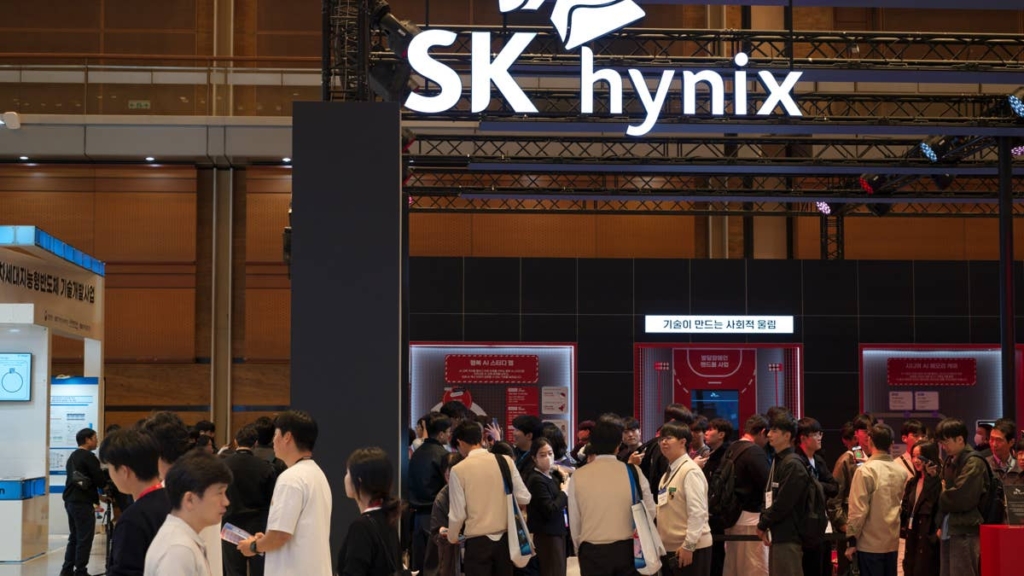
Shares of South Korean chipmaker SK Hynix (SKHY) jumped after the company reported record third-quarter earnings that beat Wall Street expectations.
The stock closed 10.89% higher in South Korea, while its U.S.-listed ADRs rose more than 12% on Wednesday, Oct. 28.
SK Hynix reported quarterly revenue of 104.62 trillion won ($78.86 billion), beating analysts’ estimates of 98.34 trillion won, according to LSEG data pulled by CNBC.
Operating profit reached 83.33 trillion won, above expectations of 76.72 trillion won.
Revenue surged 327.9% from a year earlier, while operating profit jumped 632.1%. Both figures reached record highs, with quarterly sales exceeding 100 trillion won for the first time.
The results were driven by rising memory chip prices and strong demand for high-bandwidth memory (HBM), a key component used in artificial intelligence processors.
Year-to-date, SK Hynix’s South Korea-traded stock is up 128%. Its American Depositary Receipts (ADRs) began trading on the Nasdaq Global Select Market on July 10.
But over the past month, its ADRs have fallen about 10% amid a broader pullback in semiconductor stocks.
SK Hynix sees AI memory demand outpacing supply through 2030
SK Hynix expects demand for memory chips to remain stronger than supply through 2030 as technology companies continue investing in AI infrastructure.
The company said its latest HBM4 memory chips, which began mass production and shipments in the third quarter, are expected to surpass the previous-generation HBM3E in both revenue and shipments in the fourth quarter.
HBM4 is the sixth generation of high-bandwidth memory, designed to handle the large amounts of data processed by advanced AI chips.
Average selling prices for DRAM increased by a high-20s percentage from the previous quarter, helped by higher conventional memory prices and a growing share of HBM4 products.
Also read: Meta stock falls despite Wall Street analysts raising price targets
Shipments of server DDR5 memory chips also rose more than 40% sequentially.
SK Hynix said it has secured long-term agreements with 14 major customers covering more than 50% of its production capacity for 2027 and 2028.
The company plans to significantly increase investment next year to expand production.
Management described a “virtuous cycle… in which AI-driven productivity gains… lead to greater AI adoption, which in turn drives increased investment in infrastructure.”
“As the drivers of AI investment move beyond the early stage, when a small number of companies accounted for most of it, and broaden to include general enterprises and nation-level initiatives, the global AI data center infrastructure market will continue to grow steadily,” the company said in a statement.
SK Hynix also announced plans to return about 100 trillion won to shareholders, including at least 30 trillion won in cash dividends and 60 trillion won in share buybacks and cancellations.
The company approved a third-quarter dividend of 14 trillion won, partly funded by gains from its investment in Japanese chipmaker Kioxia.
“We intend to return the gains realized from our investment in Kioxia this year to our shareholders through a special dividend,” CEO Kwak Noh-Jung said during the earnings call.
NurPhoto / Getty Images
Wall Street raises SK Hynix price targets after earnings
Rosenblatt raised its price target on SK Hynix to $400 from $320 while maintaining a Buy rating, according to The Fly.
The firm pointed to stronger DRAM pricing, noting that average selling prices increased 20% from the previous quarter.
Also read: Intel stock surges on JPMorgan upgrade after 14% weekly plunge
RBC Capital analyst Srini Pajjuri maintained an Outperform rating and a $200 price target.
RBC said annual price negotiations for 2027 have been completed and estimated that HBM prices increased 80% to 100%, which could continue supporting the company’s average selling prices.
Susquehanna analyst Mehdi Hosseini reiterated his Neutral rating, saying he preferred Micron Technology (MU) and Samsung Electronics because of their more diversified businesses.
Still, he acknowledged that SK Hynix shares appeared undervalued and said he favored the company’s U.S.-traded shares over its South Korean listing.
“I would prefer the ADR in the U.S.,” Hosseini said in a CNBC interview. He questioned whether there were enough additional buyers in the Korean market.
Related: Cathie Wood sells $16 million of surging tech stock